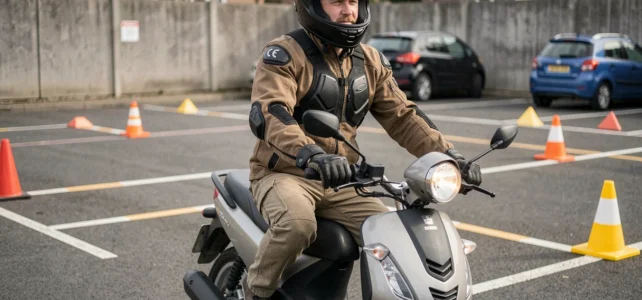
The 7-hour training to ride a 125 cm3 two-wheeler with a B license has been available since 2011. Its regulatory framework remains stable in 2026, but several concrete parameters (prices, deadlines, educational sequences, exemptions) deserve careful consideration to avoid unpleasant surprises on the day of registration at a motorcycle school.
Free pricing for 125 cm3 training: discrepancies between organizations
The administration makes it clear: the prices for the 7-hour training are free. Each motorcycle school or approved association sets its own price. The cost varies depending on the geographical area, the type of vehicle used for practice, and the level of service (equipment loan, group size).
This point is rarely highlighted in online guides, which often only display a national range. Local reality can be surprising: two organizations located in the same city sometimes show significantly different prices for the same program.
Before booking, check that the announced price covers the entirety of the 7 regulatory hours and the issuance of the training certificate. Some organizations charge extra for the loan of a helmet or gloves, which skews the initial comparison. To better understand what the 125 cm3 training certificate in 2026 entails, the legal framework specifies the actual rights it confers.
Educational content of the 7 hours: three distinct sequences
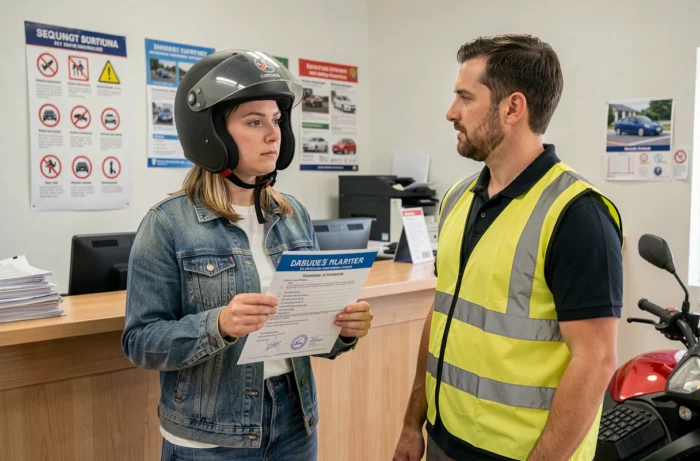
The training is divided into three blocks, the content of which is defined by the decree of March 1, 2011. Here is their distribution:
| Sequence | Duration | Main content |
|---|---|---|
| Theory | 2 hours | Accidentology, risks related to speed, detectability, effects of psychoactive substances, equipment |
| Plateau (off-road) | 2 hours | Handling, balance at low speed, braking, maneuverability |
| Traffic + assessment | 3 hours | Driving in real conditions (city and road), final evaluation without exam |
The theoretical section explicitly addresses detectability risks and psychoactive substances. These topics go beyond a simple reminder of the Highway Code: they target accident-prone situations specific to two-wheelers, often underestimated by drivers accustomed to cars.
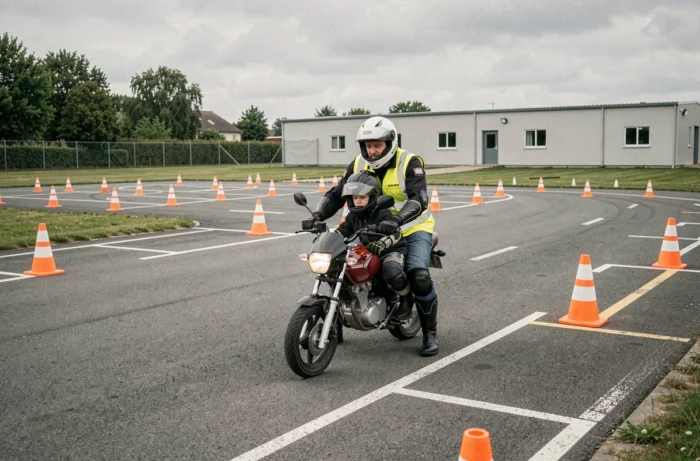
The plateau sequence allows for practicing balance and braking in a closed space. This is the moment when the habits acquired in a car show their limits: weight transfer, counter-steering, and rear brake modulation are not comparable.
The three hours of traffic include an assessment with the instructor. No final exam is required: the training follow-up certificate is issued at the end of the day, provided that all sequences have been attended.
Exemptions from 7-hour training: who is actually concerned
Not all holders of the B license go through the training. Several cases of exemption exist, and confusing them amounts to driving without valid documentation.
- Individuals who have insured and ridden a two-wheeler of 50 to 125 cm3 or an L5e motor tricycle in the 5 years preceding 2011 are exempt, provided they can justify it (insurance information statement).
- Holders of the B license obtained before March 1, 2011, who were already riding a 125 cm3 at that date also benefit from this exemption, subject to proof of insurance.
- Drivers born before 1988 are not automatically exempt from the 7-hour training: this rule concerns the BSR (AM license), not the 125 cm3 category.
The confusion between BSR exemption and 125 cm3 training exemption remains common. A roadside check with a missing certificate exposes one to a fine and, above all, to a lack of coverage in case of an accident.
Two-year B license deadline: the precise calculation to know
To enroll in the 7-hour training, one must have held the B license for at least 2 years. The reference date is the one on the license, not the date of registration at the driving school or the date of passing the theory test.
A point often overlooked: training can be taken in the 3 months preceding the 2-year anniversary of holding the license. However, actual riding of a 125 cm3 will only be allowed from the day the two years are completed.
This anticipation mechanism allows for planning the training in advance, especially for those who wish to ride from the very first day of eligibility. Motorcycle schools do not always mention this when making contact.
Certificate and insurance: two documents, two logics
The training follow-up certificate proves the right to ride a category A1 vehicle or an L5e tricycle with the B license. It must be kept on board or available in digital form during any check.
However, this certificate does not replace the insurance contract. The insurer must be informed of any change of vehicle or the addition of a two-wheeler to the household. A failure to declare can lead to a denial of compensation in case of an accident, even if the training certificate is valid.
The distinction between the right to drive and insurance coverage remains the blind spot of most procedures. Always check that your contract explicitly mentions the vehicle concerned before hitting the road.