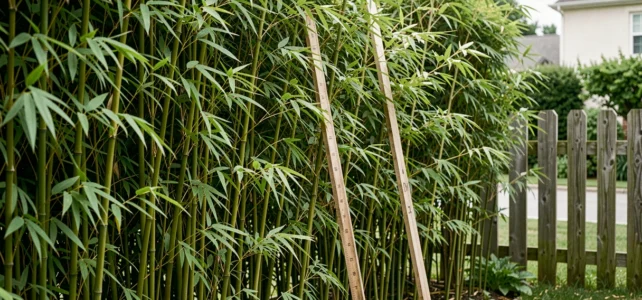
Planting bamboo as a plant fence raises a specific question: how far from the property boundary should it be installed, and what are the legal consequences in case of encroachment on the neighbor’s property? The rules vary depending on the height of the bamboo, local customs, and, recently, a new provision in the Civil Code that changes the game for victims of encroachment.
Bamboo planting distances: a comparative legal framework
The Civil Code sets minimum distances between your plantings and the neighboring property line. These thresholds depend on the mature height of the plant. Bamboo, depending on the chosen species, can reach a few dozen centimeters or exceed two meters.
| Mature height of bamboo | Minimum distance (Civil Code, art. 671) | Common case |
|---|---|---|
| Less than or equal to 2 meters | 0.50 meter from the property line | Dwarf bamboos, small bamboos trimmed into a low hedge |
| Greater than 2 meters | 2 meters from the property line | Medium and giant bamboos (Phyllostachys, Semiarundinaria) |
These distances apply by default. However, local regulations or specific customs in your municipality may impose different thresholds. Before any planting, a visit to the town hall can verify whether a local derogatory custom exists.
A point often misunderstood concerns the legislation and planting distance of running bamboos: adhering to the regulatory distance is not enough to avoid liability if the rhizomes cross the property line.

Article 1253 of the Civil Code: enhanced liability since 2024
The law n° 2024-346 of April 15, 2024, created the article 1253 of the Civil Code, which codifies for the first time liability for abnormal neighborhood disturbance. Until then, this regime relied solely on case law. The practical implications for bamboo owners are significant.
Who is targeted by this text
Article 1253 does not only target the landowner. It applies to anyone responsible for the disturbance: tenant, unauthorized occupant, beneficiary of an occupancy or exploitation title, and project owner. A tenant who plants running bamboos without a rhizome barrier thus incurs their own liability.
What this changes for bamboo as a fence
Even if you planted your bamboos at the regulatory distance, you remain fully liable for the damage caused by their rhizomes. Deformed terrace, cracked pool, destroyed vegetable garden at the neighbor’s: the codification strengthens the position of victims, who no longer need to prove fault but only the abnormality of the disturbance and the causal link.
Running bamboo at the property line: the concrete obligations of the owner
The distinction between clumping bamboo and running bamboo determines the level of precaution to be taken. Clumping bamboos form compact clumps with grouped rhizomes. Running bamboos produce rhizomes that spread horizontally, sometimes several meters in a single season.
For a plant fence with running bamboo, three obligations accumulate:
- Respect the planting distance provided by the Civil Code or local customs (0.50 m or 2 m depending on height)
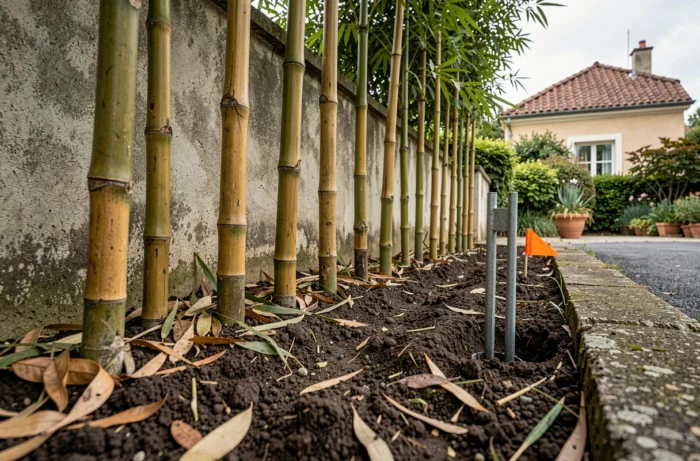
- Install a rhizome barrier deep and strong enough to prevent underground propagation to the neighboring plot
- Maintain the height of the hedge according to the declared thresholds, as a bamboo initially intended to be under 2 m that exceeds this threshold requires moving the planting back to 2 m from the boundary
The absence of a rhizome barrier does not constitute an infringement in itself, but it becomes a liability factor if the neighbor suffers damage and initiates action for abnormal neighborhood disturbance.
Prior planting: an old bamboo remains liable
A common argument is to invoke the age of the planting to evade all responsibility. The Court of Cassation clarified this point in a ruling on November 23, 2023 (Civ. 3e, n° 22-11.047): an old bamboo remains liable if it continues to cause damage.
The age of the planting does not eliminate the disturbance. As long as the rhizomes invade the neighboring property, the harm recurs and the neighbor retains the right to act. This jurisprudential position now aligns with article 1253 of the Civil Code, making the defense based on age even more fragile.
Neighbor’s recourse and steps to follow in case of conflict
When bamboos cross the property line, the neighbor has several levers. The sequence generally follows a progressive order:
- Amicable approach: registered letter requesting the cutting of the rhizomes and the installation of a barrier, with a reasonable deadline
- Mediation or conciliation: a mandatory step before any referral to the judicial court since the civil justice reform
- Legal action: referral to the judicial court based on article 1253 of the Civil Code (abnormal neighborhood disturbance) or article 671 (non-compliance with distances)
- Claim for damages: compensation for material harm (terrace, pipes, destroyed plantings) and possibly for loss of enjoyment
The neighbor can also invoke article 673 of the Civil Code, which allows them to cut the roots and rhizomes encroaching on their land, at their own expense or by requesting reimbursement if the planter’s fault is established.
Choosing clumping bamboo rather than running bamboo, combined with a compliant planting distance and a properly sized rhizome barrier, remains the least legally exposed configuration. Since the enactment of article 1253, simple compliance with distances no longer protects against liability action if the disturbance persists.