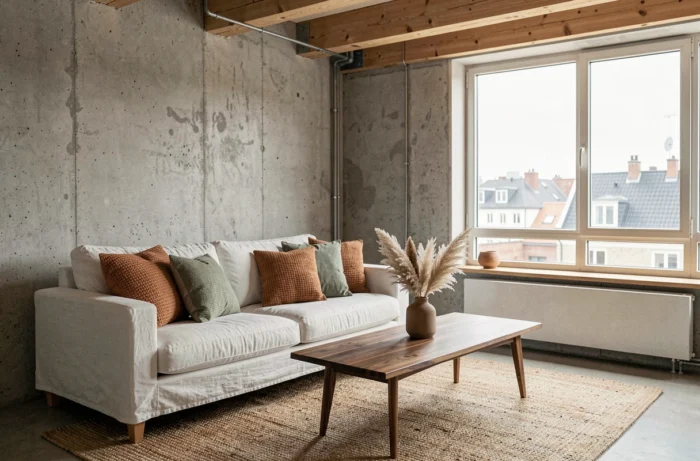
Enhancing an interior is not just about following a list of trends. The choices of materials, finishes, and decorative supports yield very different results depending on the room, the available light, and the air quality. Comparing these parameters allows for concrete trade-offs between trendy and elegant decorations, without being limited to mere fashion effects.
VOC Emissions According to Decorative Materials: An Underestimated Technical Criterion
Before even discussing style, one parameter conditions the quality of life in a decorated interior: volatile organic compounds. In France, paints, varnishes, glues, and coatings carry a label ranging from A+ to C based on their emissions. In contrast, new furniture does not benefit from a generalized equivalent labeling.
This regulatory gap weighs on decor choices. A room repainted with an A+ rated finish but furnished with new high-emission elements can present degraded indoor air quality. The current trend towards authentic materials (ceramics, raw wood, lime finishes) mechanically reduces this risk compared to particle boards or plastic-coated surfaces.
| Decorative Support | Available VOC Labeling | Emission Risk |
|---|---|---|
| Wall Paint | Yes (A+ to C) | Low if A+ selected |
| Non-Woven Wallpaper | Yes (A+ to C) | Variable depending on glue used |
| New Furniture (series) | Not generalized | Potentially high |
| Handcrafted Ceramics | Not required | Very low |
| Lime Finish | Yes (A+ to C) | Very low |
This table highlights a rarely addressed angle: choosing low-emission materials naturally steers towards a more authentic style, which also happens to be the one valued by the 2026 decoration trends.
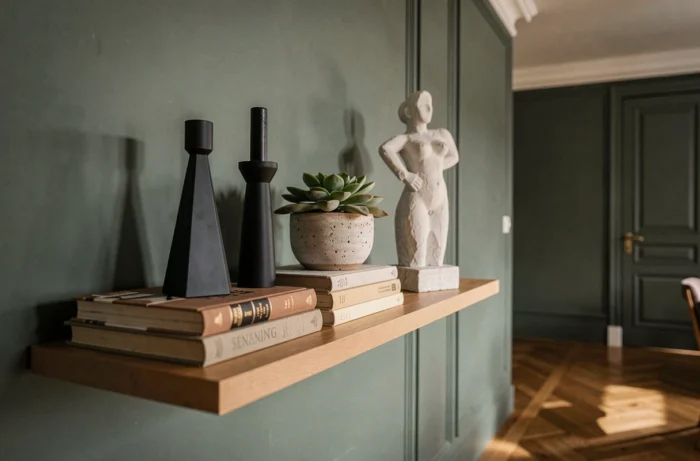
Decorative Ceiling and Screen: Two Levers to Transform a Room Without Renovation
Walls monopolize attention in most decor projects. Recent observations show that two surfaces or elements long neglected change the game, especially for living room spaces.
The ceiling becomes a true decorative support thanks to wallpaper and lime finishes. This approach goes beyond the classic logic centered on walls and allows for modifying the perception of a space without altering its volume. A ceiling treated in a dark hue (aubergine, tobacco brown) visually lowers the height of a large room and creates an enveloping atmosphere. Conversely, a light lime finish on a low ceiling opens up the perspective.
The screen, meanwhile, returns as a solution to delineate spaces without renovations. It replaces the lightweight partition or separating furniture in an open living room. Models made from raw materials (wood, woven rattan) integrate into a sober wall decoration and add a sculptural dimension to the room. To explore this type of home-oriented decorative elements, the D Day Décoration website brings together pieces that fit this logic of a defined style.
Trending Colors for Autumn 2026: Aubergine, Tobacco Brown, and Lime Compared
Several sources converge on a palette of deep, earthy colors for late 2026. Aubergine, tobacco brown, and lime tones dominate selections from specialized magazines. These shades do not work the same way depending on the support and orientation of the room.
- Aubergine is suitable for accent walls in a north-facing living room, where the cool light enhances its depth without darkening it. On a ceiling, it creates a marked cocoon effect, suitable for resting spaces.
- Tobacco brown is better suited for woodwork, frames, and wall elements. In a total look on four walls, it can overwhelm a small room. In a targeted touch (a niche, a door frame), it adds warmth without saturating.
- Lime, used as a finish rather than pure color, creates variations in texture that capture light differently depending on the time of day. It works on all supports (wall, ceiling, fireplace) and remains neutral against other decorative elements.
Aubergine and tobacco brown rarely combine on the same surfaces: their cumulative chromatic density reduces perceived brightness. Alternating one with a lime base produces a controlled contrast.
Ceramics and Bio-Sourced Lighting: Materials Highlighted at the 2026 Maison et Objet Fair
The 2026 Maison et Objet fair confirmed a shift towards materials with a strong tactile identity. Ceramics were presented as a refuge material, in opposition to the smooth industrial finishes that dominated previous years.
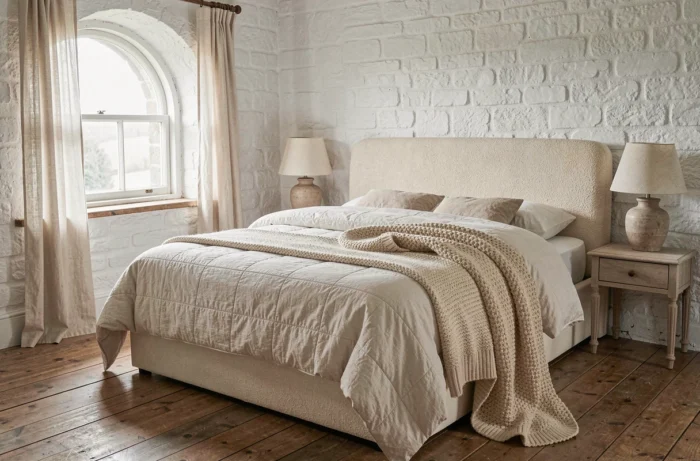
This renewed interest in ceramics in interior decoration goes beyond a vase placed on a shelf. It can be found in wall sconces, furniture handles, and structural planters. Handcrafted ceramics bring a visual irregularity that breaks the monotony of an overly uniform interior.
Lighting fixtures incorporating wax and bio-sourced filaments represent another strong signal from the fair. These pieces emit a warmer, less directional light than standard LEDs. They contribute to the ambiance of a living or bedroom space without requiring electrical modifications.
Unlike mass-produced decorative objects, these elements exhibit variations from one piece to another. The uniqueness of each piece enhances the personalized character of an interior, a criterion increasingly sought after in the face of the uniformity of online catalogs.
Timeless decor ideas share a common point: they rely on materials whose physical properties (texture, emission, aging) serve both function and aesthetics. A choice of ceramic wall decoration or a lime ceiling finish does not go out of style at the pace of an algorithm.
The most useful data remains that of the VOC table: starting from the least emissive support naturally leads to materials that, coincidentally, are also the most elegant.