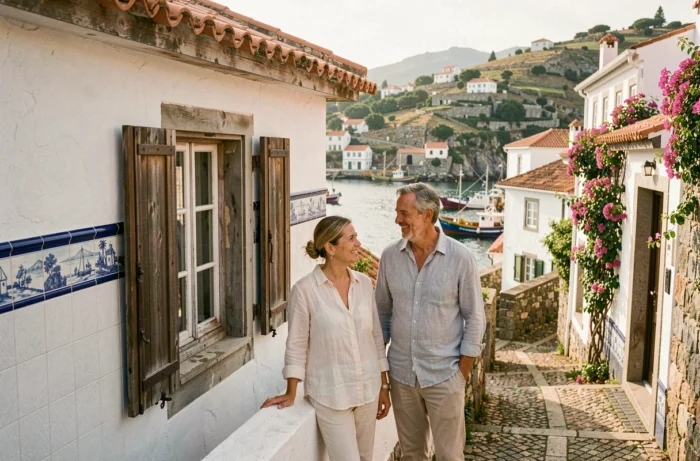
Fisherman houses in Portugal hold a unique place in the European coastal real estate market. These properties, often located in villages where fishing activities have shaped urban planning, attract foreign buyers who are neither looking for beach luxury nor city-center apartments.
The phenomenon is set against a regulatory backdrop that has significantly evolved since the end of 2024, with the lifting of several restrictions on short-term rentals and a transfer of power to coastal municipalities.
Alojamento Local License and Fisherman House: What Has Changed Since 2024
Decree-Law No. 76/2024, in effect since November 1, 2024, has lifted the national freeze on new Alojamento Local (AL) licenses that had weighed on the sector since 2023. Registrations are now, in principle, indefinite, and, crucial for investment, the AL license now follows the property upon sale.
For a fisherman house already registered in a coastal village, this means that the buyer directly inherits the right to rent short-term. The property’s value thus includes the license, which changes the financial equation compared to the 2023-2024 period when transferability was uncertain.
Those wishing to buy a house in Portugal in a fishing village must, however, check a point that the national framework does not address: municipal restrictions.
Municipal Containment Zones: The Real Filter to Know
While the national framework has become favorable again, municipalities now have the power to establish “containment zones” where new AL licenses are suspended or conditioned. Lisbon, Porto, and several coastal municipalities in the Algarve have already activated this lever between 2025 and 2026.
A fishing village located in a containment zone will not allow the issuance of a new license, even if the national framework permits it. Checking the municipal regulations before purchase has become a non-negotiable step. A property already licensed in a containment zone paradoxically gains more value, as the supply of vacation rentals is frozen while tourist demand persists.
Fisherman Houses on the Atlantic Coast: A Market Less Saturated than the Algarve
The Portuguese Atlantic coast, oriented north-south facing the ocean, remains significantly cheaper than the Algarve for seaside properties. Ground reports vary on this point depending on the locality, but the general trend shows a significant price gap between the two coastlines.
The Algarve, oriented east-west facing south, benefits from warmer and calmer waters. Prices have risen sharply there, particularly in the areas of Portimao, Lagos, and Faro. Traditional fishing villages like Tavira or Olhão, located in the eastern Algarve, retain a more authentic character, but real estate pressure is rapidly increasing.
On the Atlantic coast, locations like Ericeira (a world surfing reserve) or Nazaré still offer types of fisherman houses at more accessible prices. The Atlantic coast concentrates the best opportunities for mid-range budgets, provided one accepts a cooler ocean and more pronounced wind conditions.
Tavira and Olhão: Two Distinct Investment Profiles in Eastern Algarve
Tavira attracts buyers looking for a preserved heritage setting, with traditional architecture and a still-active village life off-season. Olhão, an old fishing port facing the Ria Formosa, offers often more compact properties, with rental potential linked to the proximity of barrier islands.
The two municipalities do not apply the same municipal rules regarding AL, creating different investment conditions for geographically close properties. Checking the local regulatory status remains the first reflex before any purchase offer.
European Regulation on Short-Term Rentals: What to Expect in 2026
Beyond the Portuguese framework, a European regulation on short-term rentals is gradually coming into effect. This tightening of control will enhance the monitoring of undeclared properties on booking platforms.
For owners of fisherman houses already compliant, this development represents a competitive advantage. Non-compliant properties will gradually disappear from platforms, reducing the visible supply and consolidating the income of properly licensed properties.
The available data does not yet allow for measuring the concrete impact of this regulation on prices in Portuguese coastal villages. The first effects will be observable from the end of 2026.
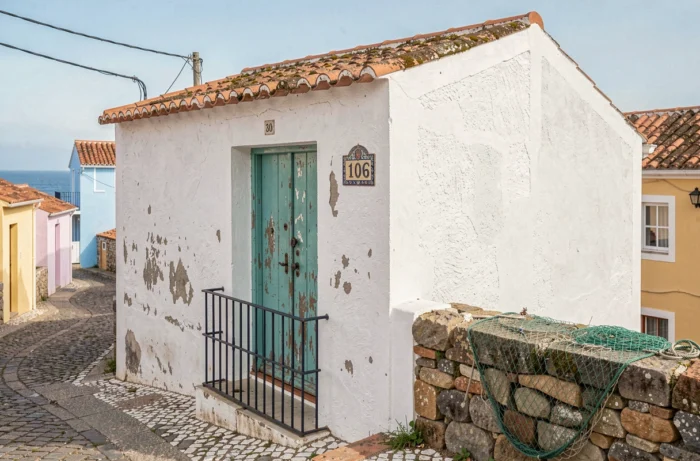
Technical Constraints of a Fisherman House: What Advertisements Don’t Show
Portuguese fisherman houses have construction characteristics that raise specific questions during renovation:
- Walls made of limestone or rammed earth, often thick but without thermal insulation, requiring adaptation work to current energy standards without altering the traditional structure.
- Reduced living spaces, sometimes below the thresholds required for certain categories of AL licenses, which can limit the number of allowed travelers.
- A permanent saline exposure that accelerates the degradation of woodwork, metalwork, and exterior coatings, leading to a higher recurring maintenance budget than a standard property.
- Heritage constraints in certain classified historic centers, where facade modifications require municipal approval, extending renovation timelines.
The cost of renovating a fisherman house often exceeds that of an equivalent property built in the 1980s-2000s. The aesthetic appeal and architectural charm come at a price that real estate listings do not always detail.
Energy Certificate and Sale: A Common Bottleneck
Any real estate sale in Portugal requires an energy certificate. Old fisherman houses generally receive low ratings, which can deter some buyers or condition access to Portuguese bank credit. Planning for the cost of meeting energy standards before signing avoids unpleasant surprises during resale.
The market for fisherman houses in Portugal is structured around a dual movement: a national regulatory framework that has become favorable again for seasonal rentals, and an increasing municipal power that creates strong local disparities. A buyer who ignores the regulations of the municipality where they invest takes a risk that neither the charm of the village nor the ocean view can compensate for.


