
The Yamaha TMAX 530 accepts three unleaded fuels available at the pump: SP95, SP95-E10, and SP98. The price differences per liter between these three options are real, but the performance differences on this twin-cylinder engine calibrated for an octane rating of 95 RON are much less significant. This article compares the technical characteristics of each fuel against the specifications of the TMAX 530 to identify what constitutes measurable gain and what is merely belief.
SP95, SP95-E10, and SP98 on the TMAX 530: Comparison Table
| Fuel | Octane Rating (RON) | Ethanol Content | TMAX 530 Compatibility | Measured Power Gain |
|---|---|---|---|---|
| SP95 (E5) | 95 | Up to 5% | Yes (manufacturer reference) | No difference |
| SP95-E10 | 95 | Up to 10% | Yes (confirmed by Yamaha Europe) | No difference |
| SP98 | 98 | Up to 5% | Yes | No measurable gain |
The key point of this table: all three fuels are compatible. SP98 does not provide any measurable gain in power or consumption on an engine calibrated for 95 RON. The extra octane of SP98 only benefits engines whose compression ratio or injection mapping is designed to utilize it, which is not the case for the TMAX 530.
Yamaha’s technical data confirms this reality. Paying more at each fill-up for SP98 does not translate into any concrete benefits on this scooter, neither in acceleration, consumption, nor engine longevity.
To delve deeper into the issue of fuel compatibility, the carburauto fr site for tmax 530 details the manufacturer specifications applicable to each engine type.

SP95-E10 and Ethanol: What Yamaha Europe Has Decided
The debate over E10 in scooters has fueled forums for years. Concerns revolve around the corrosion of fuel lines, the degradation of seals, and misfires. On the TMAX 530, these worries do not hold up against the facts.
Yamaha Europe explicitly states in the TMAX 530 manuals that SP95-E10 is officially compatible, with no impact on reliability as long as the scooter is used regularly. This mention appears in the manuals for both Euro 4 and Euro 5 versions.
Results of Real-World Tests
Independent tests conducted over several thousand kilometers confirm this compatibility in practice. Alternating between SP95-E5 and SP95-E10 results in neither misfires nor starting difficulties on the TMAX 530. The injection system adapts automatically to the variable ethanol content between the two fuels without manual intervention.
The idea that E10 would be “bad” for scooters often stems from feedback on older models equipped with rubber components not compatible with ethanol. The TMAX 530, designed after the widespread adoption of E10 in Europe, uses suitable materials.
Frequency of Use and Fuel Storage: The Real Selection Criterion
The type of gasoline matters less than how the TMAX 530 is used. It is on this point that the longevity of the fuel system truly hinges.
Daily or Weekly Use
For a TMAX 530 that runs every week, SP95-E10 is perfectly suitable. The fuel is refreshed before the ethanol has time to absorb ambient moisture. In this scenario, choosing SP95-E10 represents the most economical option without technical compromise.
Winter Storage and Prolonged Immobilization
The situation changes dramatically for a scooter that is immobilized for several weeks or months. Ethanol is hygroscopic: it absorbs water present in the air of the tank. This water, once settled at the bottom of the tank, can cause corrosion and disrupt starting.
The technical recommendation for winter storage is clear:
- Make the last fill-up before immobilization with regular SP95 (E5), whose lower ethanol content limits moisture absorption
- Fill the tank to the maximum to reduce the volume of air (and thus humidity) above the fuel
- Add a fuel stabilizer if the immobilization exceeds three months, to slow down the oxidation of the gasoline
This protocol protects the injectors, fuel pump, and fuel system lines. It applies to both the TMAX 530 and any motorcycle or scooter equipped with electronic injection.
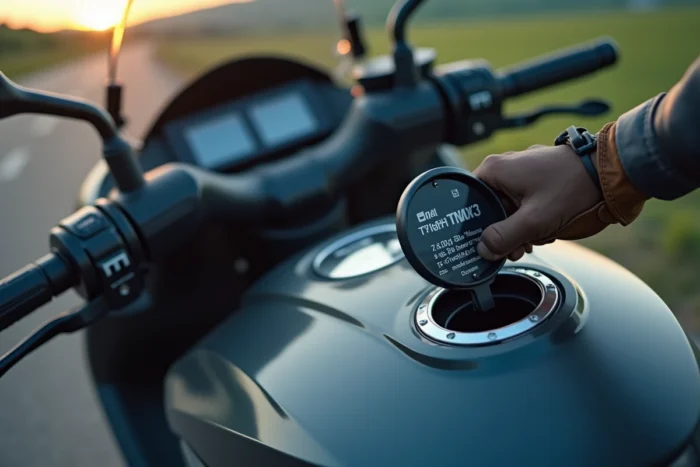
Fuel System Maintenance on the TMAX 530
The choice of fuel is part of a broader maintenance of the fuel system. A few points deserve particular attention on this model.
The fuel filter of the TMAX 530, located in the tank, traps impurities and residues from degraded ethanol. Replacing it at the intervals specified by Yamaha prevents injection pressure drops that result in stuttering at low RPM.
Regular maintenance of the fuel filter directly protects the injectors, which are among the most expensive components of the fuel system. On a TMAX 530 primarily running on E10, this vigilance is even more justified as the higher ethanol content slightly accelerates filter clogging.
Spark plugs also play a role in the optimal combustion of fuel. Worn spark plugs can mask a fuel problem or, conversely, lead to the belief that there is a fuel issue when the problem is electrical.
Summary of Best Practices
- Use SP95 or SP95-E10 for regular use, without unnecessary extra costs associated with SP98
- Switch to SP95 (E5) for the last fill-up before a period of immobilization
- Adhere to the intervals for replacing the fuel filter
- Check the condition of the spark plugs during each service
The fuel suitable for the TMAX 530 is not the one that costs the most, but the one that corresponds to the frequency of use of the scooter. For regular use, SP95-E10 remains the most rational choice. For winter storage, regular SP95 offers better preservation. SP98, on the other hand, is not justified by any technical criteria for this engine.