
A home escape game relies on three technical pillars: the design of the puzzles, the calibration of difficulty, and the staging of the space. Neglecting any of these aspects results in a flat experience, regardless of the budget invested in decoration or accessories.
Architecture of puzzles for a successful home escape game
The quality of a home escape game lies in the logical structure of the puzzles, not in their quantity. We recommend focusing on three to five interconnected puzzles rather than a dozen independent ones. A chain of puzzles where solving one provides a clue for the next creates a narrative tension that isolated riddles never achieve.
Each puzzle should engage a different cognitive channel: visual observation, logical deduction, physical manipulation, auditory association. Linking two puzzles of the same type (two combination locks, two coded messages) leads to quick fatigue, even among experienced players.
The design rule we consistently apply is: a well-designed puzzle should be solved in less than ten minutes by a motivated group. Beyond that, the group loses interest. If the pre-test exceeds this threshold, it is necessary to simplify or add an intermediate clue.
Several specialized creators now offer customized kits for specific homes, with staging around everyday objects and hidden inscriptions in the players’ actual decor. This tailored approach transforms the familiar space into a narrative playground, far beyond generic printable kits. To explore this type of turnkey format, you can learn more about Mindtrap and their scenarios adapted for home use.
Calibration of difficulty according to player profiles
A home-organized escape game often fails due to calibration issues. If it’s too easy, the experience ends in fifteen minutes and participants are left wanting more. If it’s too difficult, frustration sets in and the game master ends up giving all the answers.
Calibration is not done haphazardly. It relies on two variables: the number of players and their familiarity with the escape game format.
- For a group of novice participants (family birthday, neighborhood party), limit the puzzles to intuitive mechanics: searching for hidden objects, decoding messages with a simple alphabet, directional locks. The goal is for each player to contribute at least once to the solution.
- For regular players, introduce multi-step puzzles where the solution to one puzzle is just a component of a larger resolution. A grid of numbers that gives a word, which opens a chest containing a map, which reveals the location of the final clue.
- For a mixed group (children and adults at a birthday party), plan parallel puzzles: some accessible to the younger ones, others reserved for adults, with a convergence point where both solutions combine.
The role of the game master remains the main adjustment lever. Preparing three levels of clues per puzzle (one vague, one directed, one nearly explicit) allows for real-time pacing regulation without breaking immersion.
Scenario and staging: what distinguishes a good escape game from a treasure hunt
The scenario gives players a reason to solve the puzzles. Without a narrative thread, you end up with a treasure hunt. The difference between the two lies in the coherence between the story, the decor, and the game mechanics.
An effective scenario can be summed up in three sentences: an initial situation (who the players are in the fiction), a clear objective (finding the antidote, unlocking a chest, identifying a culprit), and a time constraint. Everything else is just decor, literally.
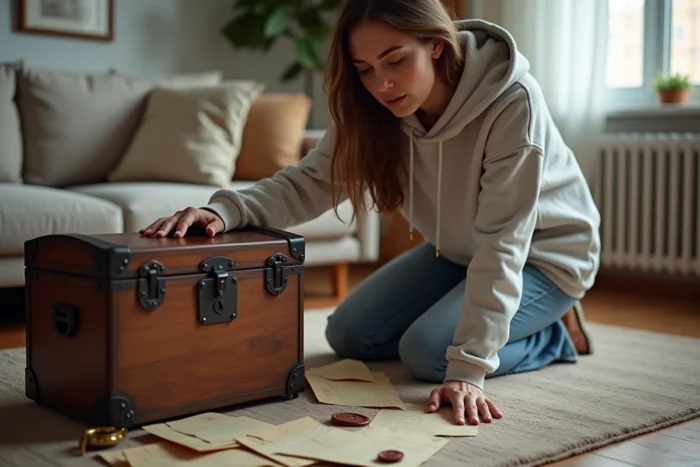
For staging, focus efforts on a single room rather than scattering clues throughout the home. A well-prepared living room with defined search areas creates better immersion than a path through five rooms where players wander aimlessly. A few elements are sufficient: dim lighting, sound ambiance played from a phone, sealed envelopes, and repurposed everyday objects.
A recent trend deserves attention: some home experiences now incorporate an outdoor phase before the final resolution inside. The garden, the hallway of the building, or the nearby park become the first act of the scenario. This hybrid format refreshes the experience for groups that have already participated in several home escape games.
Educational escape game: a growing use
The home escape game goes beyond entertainment. Teachers use this format to work on academic or language skills with their students. In 2026, 4th-grade classes with a focus on European languages and cultures designed and ran escape games in English for other students, combining learning objectives and playful mechanics.
This educational twist works because the format naturally imposes collaboration, careful reading, and step-by-step reasoning. The puzzles become disguised exercises, and the time constraint stimulates engagement much more than a worksheet exercise.
For parents organizing a home escape game for a birthday or party, incorporating one or two educational puzzles (mental math, geography, general knowledge) goes unnoticed in the flow of the game while adding a layer of value to the activity.
The home escape game remains one of the few playful formats that adapts well to both a night with friends and a school workshop or informal team building. Success depends less on the materials than on the rigor of puzzle preparation and the game master’s ability to time their interventions appropriately.