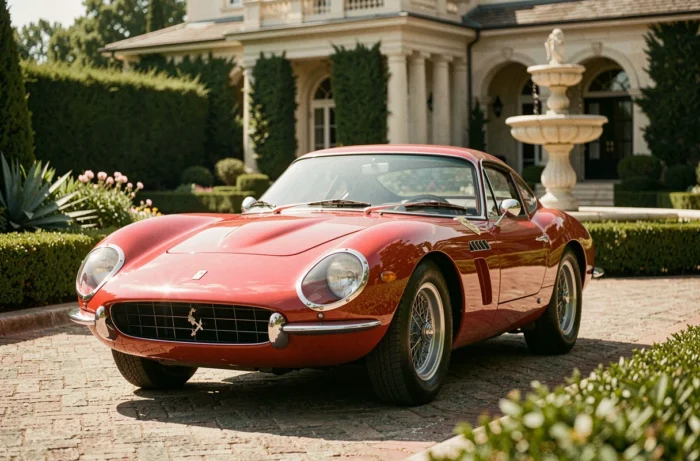
An Audi A8 W12 that belonged to Johnny Hallyday, a 1966 Shelby Cobra in Lewis Hamilton’s garage, a Ferrari Luce sold for a record price at a charity auction: celebrity cars fuel a market where nostalgia intersects with increasingly structured financial and legal stakes. The link between stars and legendary automobiles goes far beyond mere celebrity gossip.
Taxation of classic cars in France: a blind spot in celebrity articles
In France, classic cars fall under the category of art and collectible objects under certain conditions, with a specific tax regime for resale. However, this tax framework is rarely addressed in articles dedicated to celebrity vehicles.
Specifically, the owner can choose between two taxation methods when transferring ownership. This option radically changes the asset value of a vehicle that belonged to a celebrity compared to a simple classic collectible. The “collection gray card” status, issued upon certification from the manufacturer or the FFVE, also opens up a technical inspection every five years for vehicles registered from 1960 onwards.
For models kept or displayed in France, this collection gray card is not just an administrative formality. It conditions the ability to drive the vehicle, maintenance obligations, and ultimately, its valuation in the market. A complete catalog of replicas and models related to film productions is, for example, referenced on carsthestars.be, illustrating the extent of this specialized market.
Legendary movie cars and star garages: two distinct markets
It is important to distinguish between two often-confused categories. On one side, the cars actually owned by celebrities (Steve McQueen’s Ford Mustang, Lewis Hamilton’s Mercedes collection). On the other, vehicles made famous by cinema or television, with no ownership link to a specific actor.
The former derive their value from documented provenance. A certificate of authenticity, a maintenance history, or even period photographs can sway an estimate. The latter are valued primarily for their connection to a cultural work, and their worth depends more on the popularity of the film or series than on mechanical criteria.
Provenance and traceability: the crux of the matter
On specialized auction platforms, provenance documentation weighs as heavily as mechanical condition in determining price. Johnny Hallyday’s Audi A8 W12, sold at an online auction in 2021, generated interest that far exceeded the market value of the model. The journalistic report accompanying the sale traced the vehicle’s history and its connection to its owner.
In contrast, a vehicle with unclear provenance, even if associated with a famous name, struggles to reach expected price thresholds. Field reports vary on this point: some auction houses report lots that remained unsold due to insufficient documentation, even for prestigious models.
Ferrari Luce: when the star car becomes a record asset
The case of the Ferrari Luce, the brand’s first electric vehicle, reshuffled the cards in 2026. Sold at a charity auction, this unique piece simultaneously became the most expensive new car and the most expensive electric car ever sold at auction.
This result raises questions about the very nature of the market. The Luce is not an old car; it does not bear the patina of a historic model. Its value is based on three combined factors:
- The uniqueness of the piece (one-off commissioned model)
- The charitable aspect of the sale, which frees bidders from strictly commercial logic
- The symbolic shift of Ferrari towards electric vehicles, which gives the car immediate historical significance
This type of transaction blurs the line between car collecting, philanthropy, and investment. A new vehicle can now reach price levels reserved for post-war classics, provided it combines rarity, brand, and narrative.
European regulation and protection of historic vehicles
The legal framework is also evolving on the institutional side. The European regulation applicable to end-of-life vehicles provides an explicit exclusion for vehicles of historical interest. The parts necessary for preserving their historical character are also protected.
This protection is not absolute. Some vehicles undergoing restoration may require a technical evaluation within tight deadlines to avoid being classified as end-of-life vehicles (VHU). For a collector acquiring a celebrity’s car in a degraded state, the administrative process can become a real obstacle.
What this changes for private collections
Star garages, often composed of rare models maintained in exhibition condition, generally escape these constraints. The risk mainly concerns vehicles acquired on the secondary market, sometimes after years of inactivity. Available data does not allow for conclusions about the number of celebrity vehicles actually affected by these procedures, but the regulatory framework deserves to be understood before any purchase.
- Check the collection gray card status before acquisition
- Ensure that provenance documentation is complete and verifiable
- Anticipate technical inspection obligations related to the vehicle’s vintage
- Evaluate the applicable tax regime in case of resale
Celebrity cars are no longer just magazine curiosities. Between the French tax regime for collectibles, European regulation on historic vehicles, and auctions reaching unprecedented amounts, they are now part of a structured asset logic.


