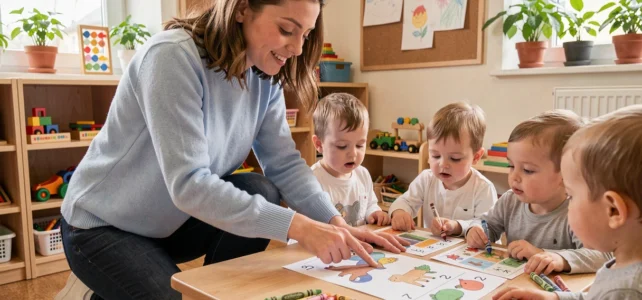
In preschool, the goal is not to write numbers or recite the number rhyme up to ten. The programs applicable for the 2025-2026 school year refocus expectations on counting small collections up to 3 and the immediate recognition of quantities (subitizing). The printable worksheets only make sense within this specific framework.
Subitizing and one-to-one correspondence on printed worksheets
Subitizing is the ability to instantly recognize a quantity without pointing to each item. For a child aged 2-3 years, this skill is limited to 1, 2, or 3 objects. An effective printed exercise leverages this mechanism: it presents configurations of dots or images that the child identifies at a glance, then associates with a written number or another equivalent collection.
We recommend prioritizing worksheets where the elements are arranged in canonical configurations (like on a die) rather than randomly scattered. Regular arrangement facilitates global recognition and anchors stable mental representations.
One-to-one correspondence requires an action: linking each object from collection A to an object from collection B. On paper, this translates to drawing lines between two columns. This type of exercise engages fine motor skills as well as logic, and it serves as a good complement to printable activities for preschoolers aged 2-3 years found online.
A common pitfall: offering collections of 5 or 6 items right from preschool. The child does not yet have a stable number chain to count beyond 3. An overly ambitious worksheet leads to mechanical counting without understanding.
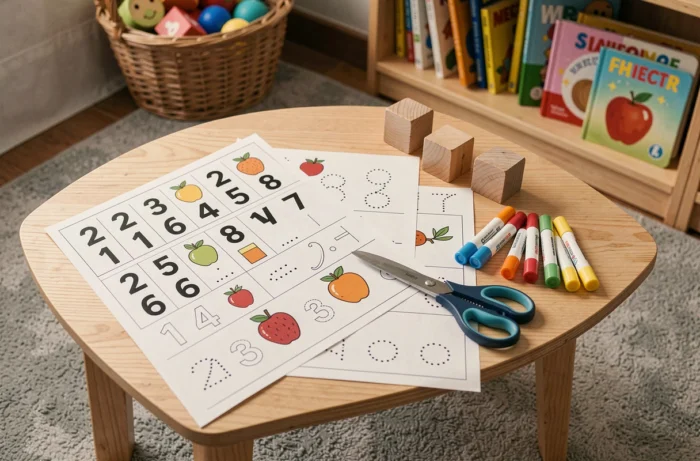
Numeration exercises for preschool: which formats work on paper
Not all worksheets are created equal. Some formats produce measurable learning, while others keep the child occupied without advancing their understanding of numbers.
Sorting and classifying by quantity worksheets
Sorting is a prerequisite for counting. On a printed worksheet, the child can be asked to circle the groups that contain “2 animals” among several boxes. This format forces comparison between collections and engages subitizing in a choice context.
Coded coloring limited to 1, 2, and 3
Coded coloring associates a number with a color. In preschool, limiting the code to a maximum of three numbers avoids cognitive overload. The child reads the number, identifies the corresponding color, and then fills in the area. The exercise connects recognition of the written number and graphic gesture.
Collage and cutting games
A prompt like “glue 2 stickers in the circle” introduces the concept of cardinality: the last number spoken indicates the total quantity. Collage adds a sensory dimension absent from simple coloring. We observe that this format holds children’s attention longer at this age.
- Worksheets for number-quantity association with die configurations (1, 2, 3 dots)
- One-to-one correspondence exercises between two columns of images
- Coded coloring with a maximum of three colors, with a simple numerical instruction
- Cutting and gluing where the child places a specific number of items in a frame
Progression and frequency of worksheets for learning to count in preschool
A printed exercise does not replace concrete manipulation. Institutional recommendations emphasize that children aged 3-4 must primarily count in real play situations (play kitchen, building, pretend shopping) before moving on to paper support. The worksheet serves to consolidate an acquired skill, not to introduce it.
In practice, we recommend not exceeding two to three numeration worksheets per week in preschool. Beyond that, the risk is transforming mathematical activity into a graphic conformity exercise. The child fills out the worksheet “correctly” without having constructed the concept.
The progression throughout the year follows a simple logic:
- First term: free manipulation (tokens, cubes, everyday objects), introduction of worksheets focused on quantities 1 and 2
- Second term: worksheets incorporating quantity 3, one-to-one correspondence exercises
- Third term: worksheets combining sorting, number-constellation association, and initial comparisons (more than, less than)
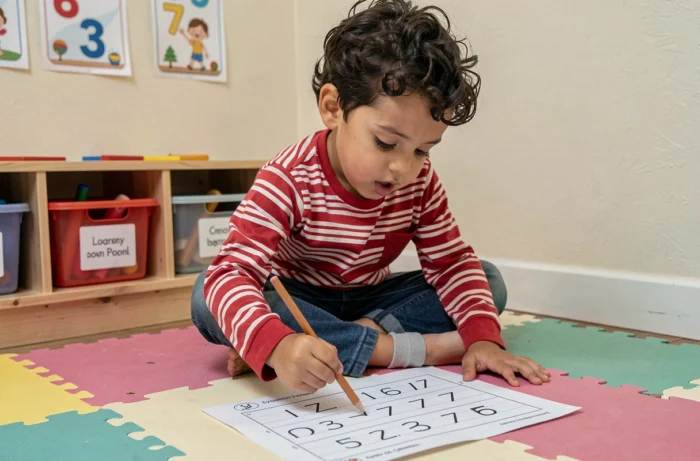
Criteria for selecting a printable preschool math worksheet
The volume of free resources available online is considerable. Not all meet the expectations of cycle 1. Here are the criteria we apply to evaluate the relevance of a worksheet.
The instruction must be understandable without reading. In preschool, the child does not decipher. A good worksheet uses a pictogram for instructions (pencil for coloring, scissors for cutting, finger for pointing) or requires only minimal oral explanation from the adult.
The level of quantity must correspond to the time of year. A worksheet proposing to count up to 5 in September of preschool is inappropriate, even if labeled “preschool.” Always check the numerical range.
The size of the illustrations also matters. The images must be large enough for a 3-year-old child to color or circle without motor frustration. Drawings that are too small or too detailed turn a numeration exercise into a fine motor skills challenge.
Finally, an effective worksheet isolates a single skill per page. Mixing counting, writing the number, and coded coloring on the same sheet disperses attention and muddles the learning objective.
The paper support remains one tool among others. Its strength lies in the trace it leaves: the child can review their worksheet, and the adult can measure progress. Its limitation is the absence of manipulation. The two work together, never one without the other.