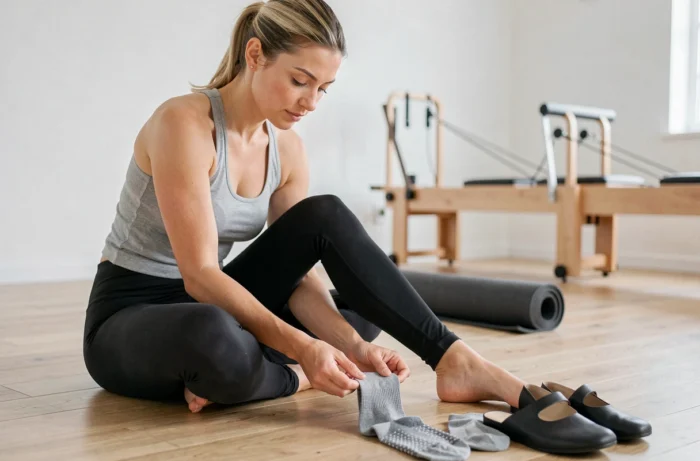
Pilates is mostly practiced barefoot. Starting from this observation helps avoid unnecessary purchases and focuses attention on situations where footwear actually adds value: sessions on the reformer, classes in shared studios, or foot conditions that require minimal support.
Proprioception and ground contact: why barefoot remains the standard in Pilates
The Pilates method relies on fine control of the center of gravity and the activation of deep muscle chains, particularly those of the foot and ankle. The sensory feedback from the bare foot on the mat is hard to match with any type of footwear. Plantar receptors transmit real-time information about pressure and texture that informs postural adjustments.
On a standard mat, adding a sole between the skin and the surface filters this proprioceptive signal. We regularly observe that practitioners used to running or fitness shoes lose precision on single-leg balance exercises as soon as they wear rigid footwear.
To delve deeper into the selection criteria suitable for each type of session, the Pilates shoes on 1 Sport 1 Coach detail the cases where footwear is justified compared to practicing barefoot.
Non-slip socks on the reformer: grip, hygiene, and limitations
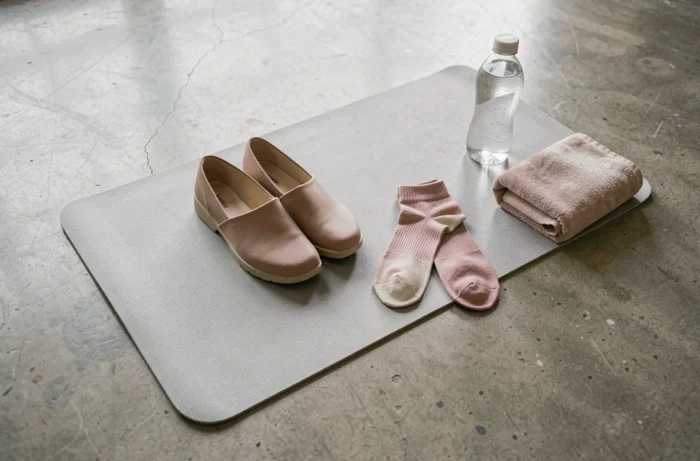
On a reformer, the situation changes. The mobile carriage, footbar, and standing exercises on the platform create traction constraints absent from floor work. Balanced Body, a leading manufacturer of reformers, specifies that grip socks are not a universal safety requirement but often comply with studio regulations for hygiene reasons.
Their technical interest focuses on two points:
- Grip on the platform and bar, where the sweat from a bare foot can reduce grip after several sets.
- Protection against repeated friction from the carriage, which can irritate the sole of the foot during long sessions.
However, standard socks (without silicone dots) can be less safe than bare feet on the smooth surfaces of a reformer. They eliminate the natural grip of the skin without compensating for it. The distinction between grip socks and standard textile socks is not trivial: it is a documented slip factor in several studios.
Selection criteria for grip socks
Not all non-slip socks are created equal. We recommend checking three parameters before purchase:
- The distribution of grip: a silicone coating limited to the heel is not sufficient. The metatarsal area (forefoot) must be covered for pushing exercises on the carriage.
- The fit on the foot: a sock that is too loose shifts during movements and negates the benefit of the grip. Support at the arch is the main control point.
- The breathability of the fabric: a blend containing a significant amount of synthetic fibers wicks moisture better than pure cotton, which quickly saturates with sweat and becomes slippery.
Fitness or running shoes for Pilates: what the sole changes
Some practitioners arrive at class wearing running or cross-training shoes. The thick cushioning of a running shoe degrades ground perception and artificially shifts the center of pressure toward the forefoot. The drop (the height difference between heel and forefoot) of a standard running shoe is well above what Pilates work requires, where foot neutrality relative to the ground is sought.
A fitness shoe with a flat, thin sole is closer to the needs of Pilates, but it remains a compromise. It may be suitable in two specific cases: a cold floor in an unheated room, or a condition like plantar fasciitis that requires minimal arch support.
The case of Nike and minimalist models
Several brands offer “barefoot” or minimalist models with a nearly zero drop and a very flexible sole. These shoes preserve some sensory feedback while providing thermal and mechanical protection. However, they are rarely allowed on studio machines (reformer, Cadillac) because rubber soles can mark padded surfaces.
For floor Pilates, a minimalist model with a smooth sole is an acceptable alternative if practicing barefoot is not feasible.
Adapting footwear to the type of Pilates session
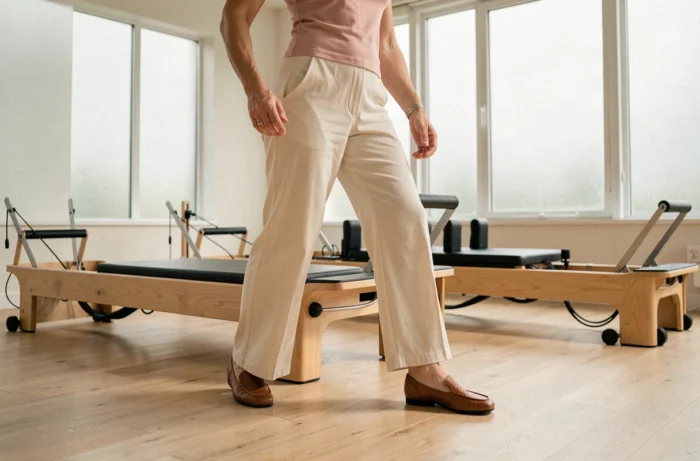
The choice is not limited to “shoes or barefoot.” It depends on the format of the session, the floor covering, and the individual sensitivity of the foot. A Pilates mat class in a heated studio calls for bare feet. A group reformer session often requires grip socks due to studio regulations. A hybrid Pilates-fitness workout on a hard floor may justify minimalist shoes.
The central criterion remains the stability of the foot on the working surface, not the comfort perceived at the time of trying them on. Footwear that seems cushy in the store may prove unstable from the first footwork exercise on the reformer. We recommend systematically testing on the practice equipment before finalizing a choice.
The most common mistake is to transpose the selection criteria of a classic sports shoe (cushioning, reinforced lateral support, thick sole) to Pilates. The discipline demands the exact opposite: maximum ground contact, total sole flexibility, and support that does not hinder toe mobility.


