Vacuum sealing promises to multiply the shelf life of food, but the differences between product categories are considerable. A raw vegetable does not react like cooked meat, and the storage method (refrigeration, freezing, room temperature) radically changes the timelines. Comparing these durations allows us to identify where vacuum sealing provides a real benefit and where it remains marginal.
Comparative table of vacuum preservation durations by food type
The durations vary according to the nature of the product and the storage temperature. The table below gathers the main food categories and contrasts traditional preservation with vacuum preservation, in refrigeration and freezing.
| Food Category | Traditional Refrigeration | Vacuum Refrigeration | Traditional Freezing | Vacuum Freezing |
|---|---|---|---|---|
| Raw meat (beef, pork) | 2 to 3 days | Up to 6 days | 4 to 6 months | Up to 24 months |
| Raw poultry | 1 to 2 days | Up to 6 days | 6 to 9 months | Up to 24 months |
| Fresh fish | 1 to 2 days | 4 to 6 days | 2 to 6 months | Up to 24 months |
| Raw vegetables | 3 to 7 days | Up to 18 days | 8 to 12 months | Up to 24 months |
| Prepared dishes | 2 to 3 days | 6 to 10 days | 2 to 3 months | Up to 12 months |
| Hard cheese | 15 to 20 days | Up to 60 days | Not recommended | Not recommended |
| Dry products (coffee, spices) | Several weeks | Several months | – | – |
The most spectacular gain concerns the freezing of animal proteins. Vacuum-sealed frozen meat can last up to 24 months, whereas conventional packaging limits the duration to a few months before freezer burn affects the texture.
For more details on the shelf life of vacuum-sealed foods by product, detailed tables exist with finer distinctions between cuts of meat, types of vegetables, or prepared dishes.
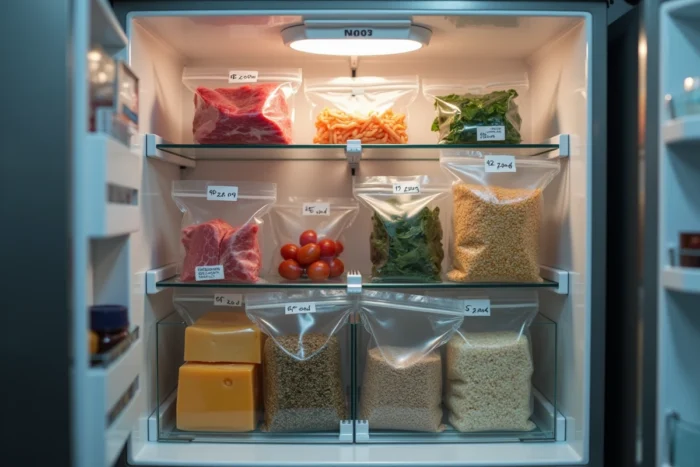
Vacuum Refrigeration: Where the Duration Gain is Truly Significant
Vacuum sealing does not produce the same effect on all foods in the refrigerator. The discrepancies deserve analysis.
Animal Proteins: The Clearest Benefit
Fresh fish goes from one or two days to four or six days. Raw meat doubles its shelf life, sometimes even more. The removal of oxygen measurably slows bacterial proliferation: about 80% of aerobic bacteria are eliminated during vacuum sealing, according to technical data from professional machine manufacturers.
This gain is directly related to the quality of the vacuum. A professional chamber machine (achieving 99% vacuum) offers better results than a domestic external suction machine, which leaves more residual air in the bag.
Vegetables and Fruits: A Real but Conditional Gain
Raw vegetables go from a few days to nearly two and a half weeks. However, this result assumes a fresh product at the time of packaging and a stable refrigerator temperature between 0 and 4 °C.
High-water-content fruits (strawberries, tomatoes) do not handle bag compression as well. Firm vegetables (carrots, peppers, zucchinis) benefit the most from vacuum sealing in the refrigerator.
Cheeses and Dry Products: Special Cases
Hard cheeses are the big winners in the refrigerator. Their shelf life can triple. Dry products (whole coffee beans, spices, nuts) mainly benefit from protection against oxidation and moisture, preserving aromas for several months at room temperature.
Vacuum Freezing: Why the Durations Are So Long
Freezing alone already preserves food for several months. Vacuum sealing adds a specific advantage: the absence of air prevents freezer burn (those white spots that dry out the surface of foods).
This phenomenon explains the discrepancies observed in the table. Meat frozen in a conventional bag gradually loses taste quality long before it becomes unfit for consumption. Under vacuum, the texture and flavor remain intact much longer.
Prepared dishes frozen under vacuum last up to a year, compared to two to three months in standard packaging. This gain is particularly interesting for batch cooking enthusiasts, who prepare meals for the week in a single session.

Traceability and Materials: What Preservation Tables Don’t Tell You
The stated durations assume controlled conditions. Two technical factors are often absent from practical guides.
- The food contact suitability of bags and containers must be verified. During inspections, the Food Safety Police (SSA), operational since January 2024, checks the compliance of materials used for vacuum packaging.
- Food service professionals must keep manufacturing diagrams and temperature records (cooling, reheating) to justify the shelf lives stated on their vacuum-sealed products.
- Labeling with a use-by date (DLC) remains mandatory for refrigerated vacuum-sealed products, even for internal use in a restaurant.
These documentary requirements do not directly concern individuals, but they remind us that the shelf life of vacuum sealing is only reliable if the cold chain and packaging quality are maintained throughout.
Vacuum sealing multiplies the shelf life of most foods by three to five times, provided there is sufficient vacuum, suitable bags, and stable storage temperature. Frozen animal proteins show the most marked gain, while dry products mainly benefit from better aromatic preservation. The technique does not replace the rigor of the cold chain: it amplifies it.